Satsu
Memoirs of a GeishaSatsu, later known as Yukiyo, is Sayuri’s older sister, separated from her when the sisters are brought to Kyoto and divided between different households. Their reunion at Tatsuyo offers a brief return to familial closeness, but it does not reverse the separation: Satsu remains beyond Sayuri’s reach through the years that follow. The loss becomes one of the enduring absences through which Sayuri understands her own life, and, in her final reflections, Satsu lives on within her as part of the past she carries.
Identity and Background
Satsu is six years older than Sayuri. In the family’s elemental language, Sayuri resembles their mother, while Satsu resembles their father; the sisters’ differences are also rendered through a comic account of Satsu’s awkward luck. She can accomplish ordinary tasks, but they seem to happen by accident: even carrying a fish wrapped in paper, she is cut by one of its fins. The portrait makes her distinct from her more observant younger sister without making her merely a foil. Satsu belongs to Sayuri’s first world of family, before that world is broken apart.
Separation in Kyoto
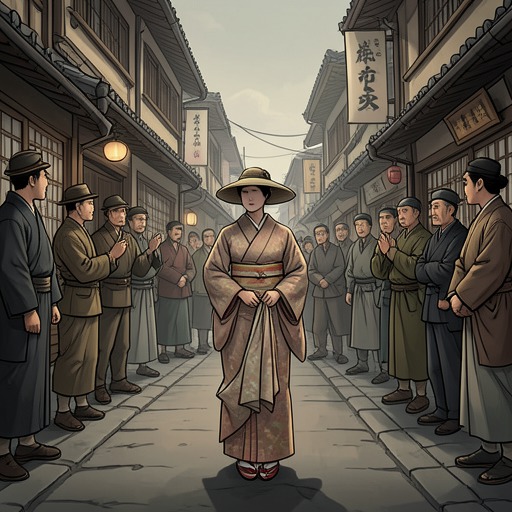
When the girls arrive in Kyoto, Mr. Bekku allows Sayuri to get out of the rickshaw but pushes Satsu back and tells her she is going elsewhere. The sisters look at one another, and Sayuri recognizes that they understand each other’s feelings completely, but the moment lasts only an instant before she is dragged away. The separation is thus not a choice either girl makes; it is imposed by the arrangements that divide them.
Sayuri later searches for Satsu and is told by an older woman that no one of that name is there. A younger woman corrects her: the girl is now called Yukiyo, though her name used to be Satsu. The older woman insists that she has no Satsu for Sayuri and does not want trouble. The exchange reveals both the name change and the precariousness of Sayuri’s search: the relationship that is self-evident to the sisters is not something the household will acknowledge for her sake.
Reunion at Tatsuyo
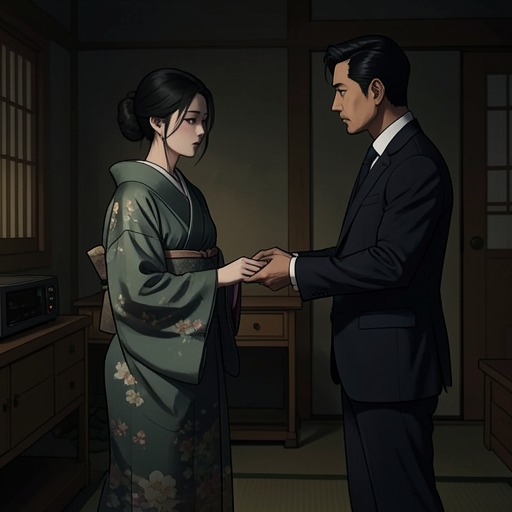
Sayuri waits until Yukiyo’s customer has left. When Satsu appears at the doorway, Sayuri recognizes her voice before the reunion becomes visible. Satsu’s pale-looking skin, brightly colored kimono, painted mouth, and sash tied at the front mark the difference between the sister Sayuri remembers and the woman she has become. Yet recognition is immediate: Satsu cries out and covers her mouth with her hand, while Sayuri rushes toward her, overwhelmed by relief and excitement.
The meeting must be kept hurried and concealed. Satsu warns that the mistress will be angry, goes back inside briefly, and returns after putting several coins into the older woman’s hand. She takes Sayuri to a spare room and explains that a cough will warn them that the mistress is coming. The reunion is genuine, but its circumstances deny it the ease of an ordinary family visit. Even their time together is conditional on secrecy, payment, and the possibility of interruption.
Separation and the War Years
The available account does not supply a later meeting or a settled account of Satsu’s life. During the war, living in poverty with the Arashino family, Sayuri thinks again about the sister who ran away. She had carried, without fully admitting it, a belief that their paths would eventually bring them together. She imagines that Satsu might write to her through the Nitta okiya or return to Kyoto looking for her.
That hope yields to a practical understanding of the obstacles. Sayuri realizes that someone living in poverty cannot simply travel to a distant city, and that the sisters might no longer recognize one another even if they met. Her imagined letter is no solution: Satsu does not know the name of the Nitta okiya, and Sayuri believes she would never approach Mr. Tanaka. As she walks beside the river with Juntaro, she trickles water onto her face while smiling, concealing her grief from the child. The gesture makes the separation present without turning it into a reunion or supplying a resolution the narrative does not give.
Memory and Significance
Satsu’s absence returns when Sayuri dances before the Chairman to “Cruel Rain.” To express the dance’s sorrow, Sayuri thinks not only of the loss she fears in her relationship with Nobu, but also of the bitterness of her permanent separation from Satsu. The dance gives the sister’s absence a place in Sayuri’s public artistic expression: private family grief becomes part of the feeling she communicates through performance.
Near the end of her life story, Sayuri dreams that people who have died or left her continue to live within those who remember them. She includes Satsu among the people she imagines drinking in, alongside her parents and others who shaped her life. Satsu’s narrative significance therefore rests not on a documented return but on the persistence of her bond with Sayuri. The early separation, the constrained reunion, and the later recognition that distance may be irreversible all prepare for this final understanding: being gone does not mean being erased from the lives of those left behind.